
From process development to a documented cell preparation.
Beike's Regional Cell Preparation Centers use defined protocols, controlled processing and batch records. Requirements are agreed for each programme; preparation by a controlled process does not by itself establish regulatory approval or clinical suitability.
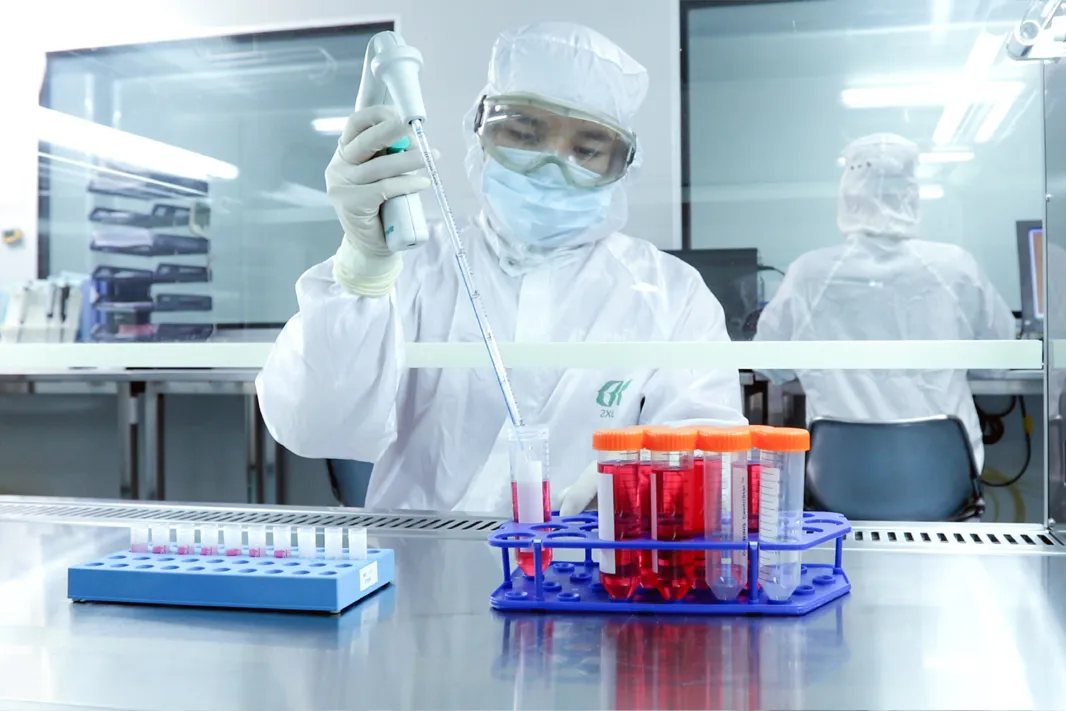
Four service tracks across the manufacturing stack.
Process development
Custom protocol design for new cell-therapy programmes; pilot to scale-up.
Controlled preparation
Closed-system processing in cleanroom suites, with programme-specific batch records.
Quality testing
Identity, potency, sterility, mycoplasma, endotoxin — backed by independent CNAS labs.
Release & shipment
Cold-chain release with documented chain-of-custody for the authorised receiving site.
A six-stage framework adapted to each programme.
- 01
Starting material intake
Source verification, identity check, intake QC and chain-of-custody opened on arrival.
- 02
Cell isolation & seeding
Tissue dissociation or selection (depending on cell type), seeding under closed-system conditions.
- 03
Controlled expansion
Expansion under defined media and atmosphere, monitored in process by automated cell-manufacturing lines.
- 04
Harvest & formulation
Cells are harvested, washed and formulated to the quantity and composition defined by the applicable protocol.
- 05
Release testing
Identity, viability, potency and microbiological test requirements are defined for the programme, with third-party verification where required.
- 06
Cold-chain dispatch
Defined transport conditions, batch documentation and chain-of-custody are handed over to the authorised receiving site.
A fully automated, closed-system cell-manufacturing line.
Beike reported deploying an automated, closed cell-processing system with supporting industrial software in 2022. Earlier company figures cited more than 100 preparation batches and 15,000 operating hours; those dated figures describe system use, not product approval or clinical performance.
High cleanliness
Fully automatic, fully enclosed line achieving Grade-A environmental maintenance and contamination control.
High stability
End-to-end automated, standardised preparation that improves the consistency and uniformity of cell-product quality.
High intelligence
Customisable manufacturing modules, intelligent cell identification and status evaluation, dynamic inventory planning and production-safety monitoring.
High capacity
24-hour uninterrupted operation to meet large-scale cell production and raise preparation efficiency.
Beike reports operating a Grade-B clean workshop at its headquarters. The current facility classification, monitoring data and permitted activities should be confirmed for the programme being evaluated.
Example release-test categories used in defined preparation protocols.
| Test | Method | Acceptance |
|---|---|---|
| Identity | Cell-characterisation panel and material identity checks. | Defined by protocol |
| Viability | A validated viability assay appropriate to the preparation. | Threshold defined by protocol |
| Potency | Cell-type-specific functional assay where required. | Defined by protocol |
| Sterility | Applicable compendial or validated microbiological testing. | Defined by protocol |
| Mycoplasma | Applicable compendial or validated detection method. | Defined by protocol |
| Endotoxin | Validated endotoxin test on the applicable formulation. | Limit defined by protocol |
Six macro regions, one integrated preparation network.
Regional Cell Preparation Centers provide processing capacity across South, East, Central, North, Southwest and Northwest China. The responsible site and transport requirements are selected for each programme.
- South China
- East China
- Central China
- North China
- Southwest China
- Northwest China
Discuss a defined preparation programme.
Share the intended use, development stage, receiving institution, jurisdiction and required quality evidence with the preparation team.
Partner with our preparation team →