The Ice Bucket Challenge has been creating a butterfly effect for many days, igniting the internet. In the hot summer of 2014, a bucket of ice water was poured over the heads of Microsoft’s Bill Gates, Facebook’s Zuckerberg and Sandberg, Amazon’s Bezos, and Apple’s Cook. These Silicon Valley tech figures, willingly drenched on camera, threw themselves into the cause like moths to a flame, all to win more help for ALS patients. The activity, which has swept across the United States, has now spread to China. The aim is to make more people aware of the rare disease known as “frozen man syndrome,” while also raising charitable funds.
”The Ice Bucket Challenge”
The Ice Bucket Challenge#, full name “ALS Ice Bucket Challenge,” requires participants to post online a video of themselves dousing their entire body with ice water, then nominate three friends to take part. Those nominated must either accept within 24 hours or donate USD 100 to the foundation fighting amyotrophic lateral sclerosis. The activity aims to raise awareness of the rare disease known as “frozen man syndrome” while also raising funds.
”Frozen Man Syndrome”
What exactly is ALS? Commonly known as “frozen man syndrome,” it is one of the world’s rare diseases, caused by hereditary and sporadic factors. It is incurable and fatal, and patients generally die within 3-5 years of onset. ALS patients remain conscious as they helplessly watch their bodies become “frozen,” with paralysis gradually spreading throughout the body until they cannot breathe.
In the early stages, ALS symptoms include muscle weakness or stiffness in movement, possibly accompanied by muscle wasting and difficulty swallowing. In the late stages, patients lose their ability to move altogether. However, their cognitive abilities are usually unaffected, so they are often called “conscious vegetative patients.”
According to the ALS Association website, an average of 15 people are newly diagnosed with ALS every day, with an incidence of approximately 2 to 5 per 100,000. ALS occurs across all races, ethnicities and societies worldwide, and anyone can be affected. As a rare disease, ALS is unfamiliar to the vast majority of people. The most well-known patient is British physicist Stephen Hawking. After contracting the disease, the expected survival time is generally 3-5 years, with only 5% of patients living more than 20 years; Hawking is fortunate to be among that 5%, having battled ALS for more than 40 years.
Beike Employees Bravely Take on the ALS Challenge
Beike Biotech has paid attention to ALS and similar refractory neurological disorders, and has contributed to the academic exploration of the field! As early as 2010, Beike Biotech took the lead in publishing in the Journal of Translational Medicine a paper on the use of cord blood mononuclear cells to treat central nervous system degeneration (including 12 ALS patients), preliminarily proving good safety. In addition, Beike Biotech’s papers on using stem cells to treat hereditary ataxia (HA) — another traditional refractory disease of the central nervous system — were published in 2011 and 2013 respectively.
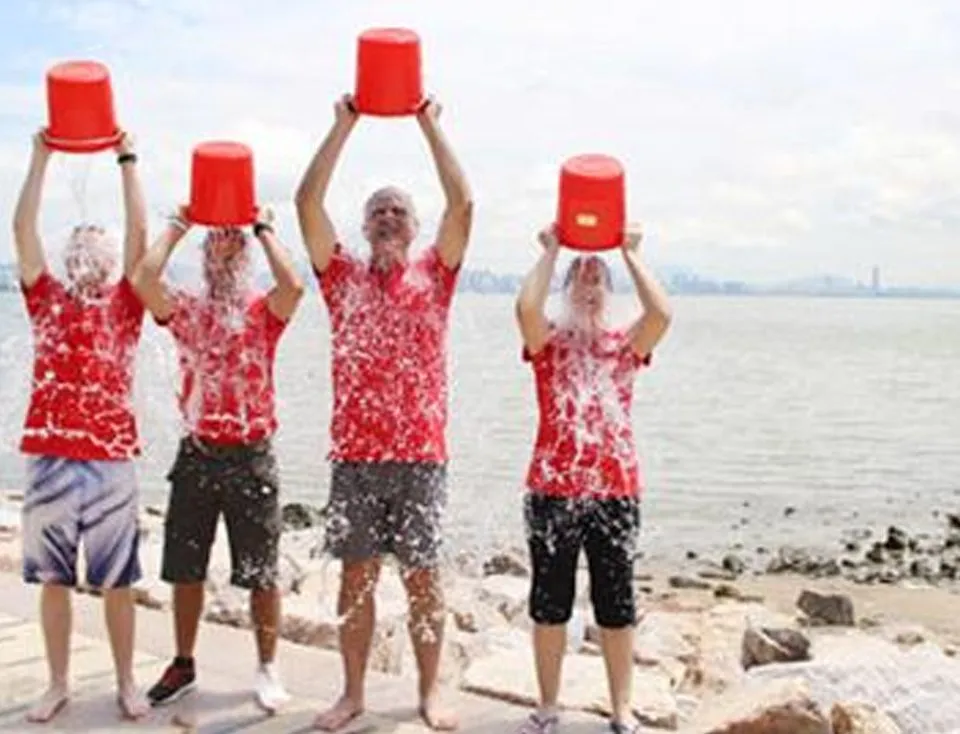
On August 20, colleagues from Beike Biotech’s International Department represented Beike in completing this challenge. The group drove to Shenzhen Bay and poured ice water and ice cubes over their heads, experiencing the “freezing” feeling. Beike Biotech has long been dedicated to human health. At the upcoming 2014 Shenzhen International BT Leaders Summit in September, Beike Biotech will focus on the cutting-edge R&D and applications of the cell therapy industry, introduce R&D progress in cell therapy and regenerative medicine, discuss the current status, trends and market needs of cell therapy and regenerative medicine, and explore industry development prospects, with the aim of providing more clinical practitioners with innovative technologies and disease solutions and offering more patients advanced medical services. “Frozen man syndrome” shares many similarities with progressive muscular dystrophy, but the latter progresses more rapidly and is irreversible. Beike’s stem cell technology can use stem cell transplantation to replace and repair damaged cells in patients, restoring tissue function, and aim to treat progressive muscular dystrophy.
Through this activity, Beike’s International Department also hopes to increase social attention to rare disease patients, and to bring more support to help rare disease patients find a path back to normal life. Beike has always been working to advance the cause of human health!
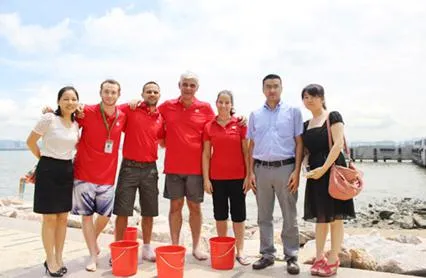
Beike Biotech International Department
The Ice Bucket Challenge may cool off quickly, but attention to ALS itself needs to be sustained over the long term. Driven by charity, social networks and the celebrity effect, this Ice Bucket Challenge has spread widely and persisted for a long time, becoming a typical online viral event. Perhaps amid the public spectacle, growing attention and growing charitable donations can help more ALS patients — and that is the common goal we all share.
For the full Beike Biotech ALS# Ice Bucket Challenge#, see herehttp://v.youku.com/v_show/id_XNzU5MjEzMzQw.html. We invite you to take part. We call on the public to pay attention to ALS (amyotrophic lateral sclerosis) and to pass on this love. Overseas website www.als-ny.org. Micro-charity donation: http://t.cn/RPQjMWW.