
Bronchopulmonary dysplasia (BPD) is the most common respiratory disease in preterm infants and one of the major causes of neonatal mortality[1]. Existing BPD treatments are mainly comprehensive prevention and management measures, including improving pulmonary surfactant, lung-protective ventilation as respiratory support, and caffeine citrate. However, under existing treatments, the various prognostic indicators of BPD have not significantly improved, and the incidence has even increased. At present, there is no unified, effective drug for the clinical treatment of BPD, so finding new therapeutic strategies to improve this severe and refractory disease has become an extremely urgent need.

Inflammatory injury is the main cause of bronchopulmonary dysplasia in newborns. Mesenchymal stem cells (MSCs) derived from umbilical cord tissue, owing to their low immunogenicity and strong immunosuppressive capacity, have become the stem cell type of choice for the treatment of inflammatory injury diseases, bringing hope to the treatment of bronchopulmonary dysplasia. To date, there are many domestic and international reports on the efficacy of MSCs in improving lung injury related to preterm infants.
For mesenchymal stem cell therapy of bronchopulmonary dysplasia, in vitro expansion to obtain sufficient MSCs is a prerequisite for clinical treatment. In past pre-clinical and clinical studies of BPD treatment, fetal bovine serum (FBS) was mostly used as a culture additive for human-source MSCs[2]. However, this no longer meets the latest requirements of the Center for Drug Evaluation of the National Medical Products Administration (NMPA) for human-source stem cell products: "the use of animal-sourced materials in stem cell product manufacturing should be avoided as much as possible." At the same time, as a heterologous protein, fetal bovine serum, when used to culture and expand human-source MSCs, will increase their immunogenicity and promote cellular senescence[3]. Therefore, efforts are being made worldwide to find replacements for fetal bovine serum. At present, a commercially available human platelet lysate (hPL) used as a culture additive for mesenchymal stem cells has attracted significant attention from researchers.
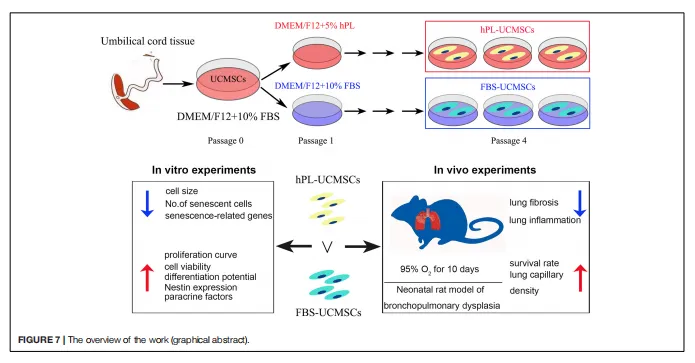
At the same time, in in vivo experiments, the study constructed a neonatal rat BPD model to evaluate therapeutic efficacy. The results showed that after hPL-UCMSCs treatment, the development of small alveoli at the bronchial terminals was promoted; the number of small alveoli increased significantly compared with the FBS-UCMSCs treatment group and the saline control group; collagen deposition was significantly reduced; pulmonary fibrosis was clearly improved; the number of new blood vessels increased significantly; macrophage infiltration was reduced; and the damaged state of the lung was significantly improved. The animal experiment results all confirmed that the therapeutic effect of hPL-UCMSCs was significantly better than that of FBS-UCMSCs.
This study demonstrated the functional role of hPL as a supplementary additive for UC-MSC culture, indicating its important clinical use value. This will help advance the wide application of hPL in future scaled-up UC-MSC culture and provide more support for the clinical treatment of BPD pediatric patients.
With 16 years of dedication to the cell field, Beike Biotech possesses a top, mature stem cell research team and cutting-edge cell storage and preparation technologies. To date, it has filed 108 patents in the biomedical field, with 56 of them granted; has undertaken more than 60 national, provincial and municipal scientific research projects, including 863 Programs and Torch Programs; and has published more than 100 papers in the cell field, including more than 40 SCI papers, with cumulative impact factor (IF) exceeding 200.
References:
[1] Arrigoni et al, Cell, 2009; Willis et al, Am. J. Respir. Crit. Care Med, 2018
[2] Chang et al, Am. J. Respir. Cell Mol. Biol, 2014; Reiter et al, Respir. Res, 2017
[3] Trubianietal et al, Part C Methods, 2015