Interviewed in the Shenzhen Commercial Daily Innovation Salon
11 November 2022
Reporter Wang Hairong
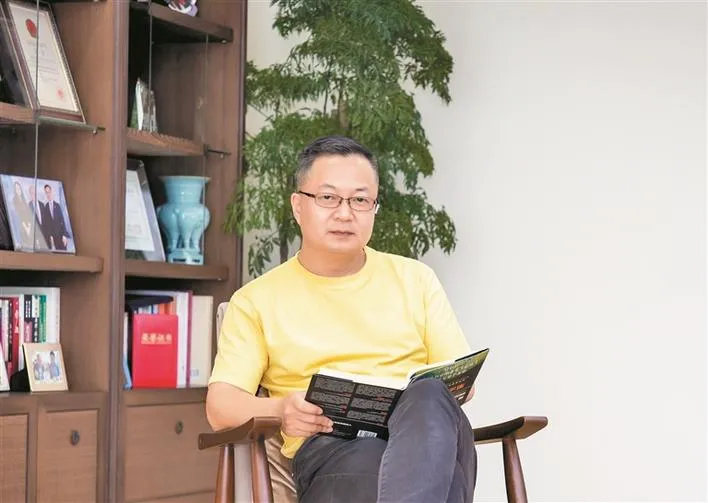
A few days ago, just back from a business trip to Heilongjiang, Dr. Hu Junyuan, Chairman of Shenzhen Beike Biotechnology Co., Ltd., had already swapped his suit for casual wear, leaving everyone who saw him with an impression of full energy.
This Guizhou native, who has been working in the cell field for more than 20 years, still maintains the same fast-paced work habits he had when he started the business. As long as he is not on the road, come rain or shine, he reaches the company's headquarters tower in Shenzhen Hi-Tech Industrial Park, Nanshan, before 9 a.m.
Building bridges and laying roads for cell therapySeventeen years ago, Beike Biotech was founded in Shenzhen. In the early days, Beike, through its independently innovative stem cell technology and the decentralized model of personalized cell therapy, rapidly translated research achievements into new methods of clinical medical service, while also feeding back clinical-practice information to basic researchers, pioneering the prototype of China's cell therapy industry translation.
Soon after, Beike launched the much-watched "Networking Project". In September 2015, the Shenzhen Comprehensive Cell Bank and the Shenzhen (Beike) Regional Cell Preparation Center, built by Beike, were inaugurated. These are key support and innovation platforms for Shenzhen's development of the personalized cell therapy "innovation chain + industrial chain".
Today, Beike has rolled out its "Comprehensive Cell Bank + Regional Cell Preparation Center" footprint across South China, East China, Southwest China and Northwest China, building an innovative public technology platform and infrastructure for the clinical translation of cell therapy technology in China.
A specialist talent pipeline drives healthy industry developmentScience and technology are the foremost productive force, talent is the foremost resource, and innovation is the foremost driver. On the second floor of Beike Biotech's headquarters, the reporter saw a wall full of personnel photos – of staff who have obtained junior, intermediate and senior professional titles in cell preparation and cell quality management.
"We must foster an environment that respects talent and supports talent growth, and use the building of a specialist talent pipeline to drive the healthy development of the cell industry," Hu Junyuan said.
In 2021, Beike brought in Professor Cai Cheguo as Chief Scientist, leading the team to open up a new R&D pipeline – organoid research, developing in vitro drug-testing systems based on organoid models. In June this year, Beike Biotech was approved to establish a Shenzhen Academician (Expert) Workstation, cooperating with Academician Wang Zhengguo of the Chinese Academy of Engineering on stem cell research in regenerative medicine and the treatment of related diseases.
Sustained R&D deployment has allowed Beike to firmly grasp the "ox by the nose" of scientific research. According to statistics, the company has undertaken more than 60 national, provincial and municipal research projects, including 863 Program projects and Torch Program projects. As of October this year, Beike has filed 132 patents in the biomedical field, of which 105 have been granted, and has led the drafting and formulation of many standards, including China's first local standard for cell preparation centers.
Embracing the medical AI waveHu Junyuan believes that, as an innovation-driven enterprise, when looking at future development, one must dare to break with conclusions based on traditional experience and better grasp the slope and trend of development. One must use "consequence-cause thinking" – first determining the desired future outcome and goal, then matching the necessary skills and allocating time accordingly, so that innovation factors such as technology, talent and capital can be combined efficiently.
"Over the next 5–10 years, the bioeconomy cannot do without digital technology. Medical AI will be the biggest opportunity in the life and health field – we cannot ignore it, much less be absent from it." Hu Junyuan revealed that Beike is planning the construction of the world's largest metabolomics testing platform, with the aim of providing new data sources for medical AI.
Beike has also invested in setting up Shenzhen Maitu Precision Technology Co., Ltd., which uses a self-improved quality control system and enhanced mass spectrometry data processing algorithms to study the biological mechanisms hidden behind big data.
Since the start of this year, Beike Biotech has signed agreements with the Heilongjiang provincial government, the Yueyang municipal government in Hunan and the Yunnan provincial government, with plans to lay out and build a Digital Life International Research Institute, a medical big data trading platform, an intelligent ECG-clothing base and wearable medical device projects.
In Hu Junyuan's view, intelligent wearable devices are an important vehicle for delivering medical AI; like high-definition cameras, they can systematically and visually measure data sources related to disease, and use modern algorithms and computing power to help the human brain diagnose diseases more efficiently.
"As the new generation of information technology is more deeply applied, the life and health industry is undergoing profound change. By this time next year, you will see this change more clearly," Hu Junyuan said.