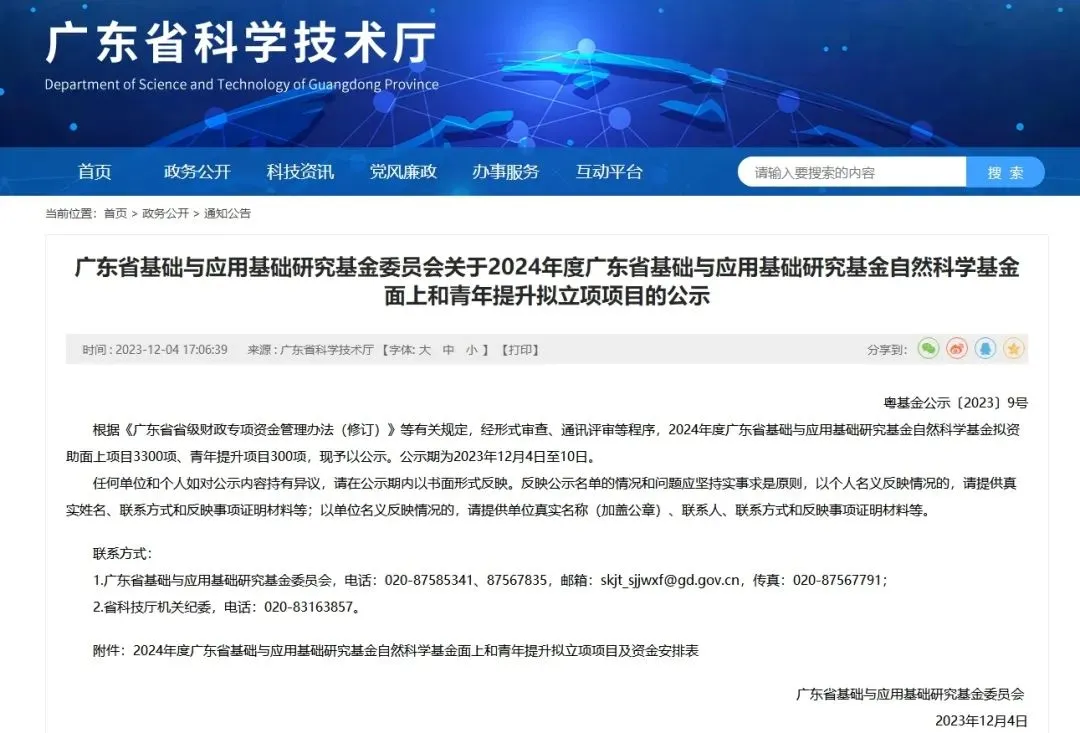
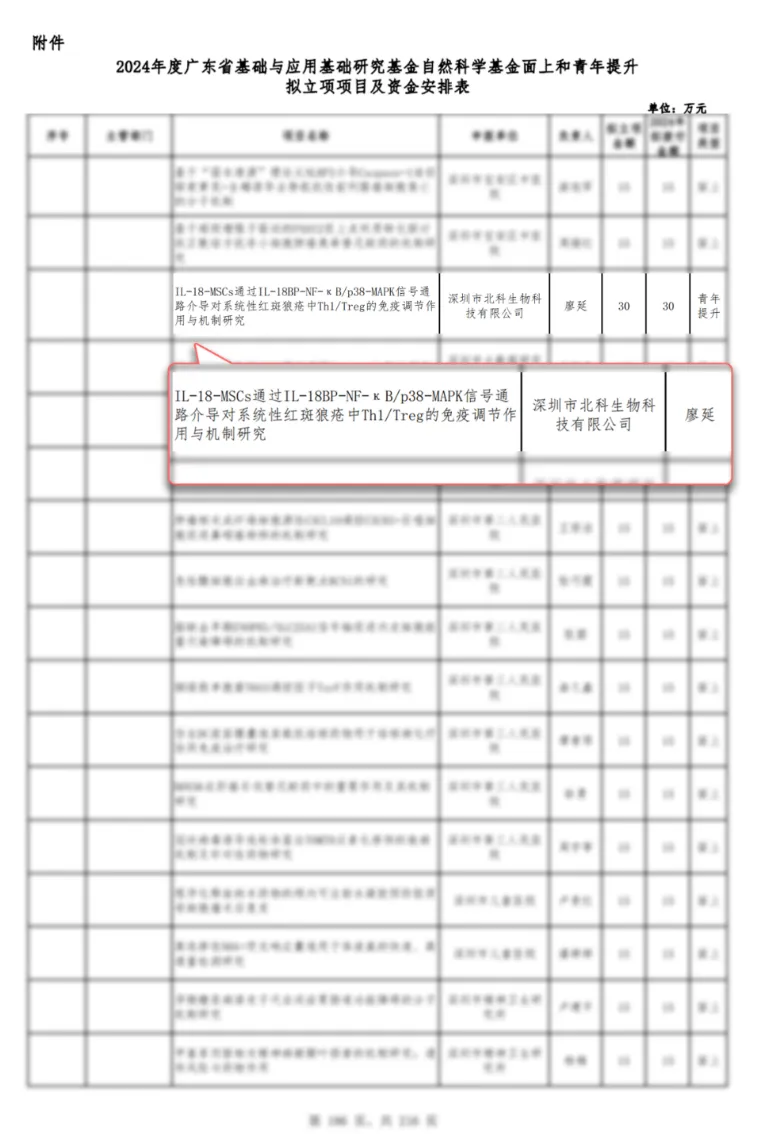
On December 4, 2023, the website of the Guangdong Provincial Department of Science and Technology released a notice on the 2024 Guangdong Basic and Applied Basic Research Foundation Natural Science Foundation general projects (3,300 projects at 150,000 yuan each) and 300 Youth Promotion projects (300,000 yuan each), with the public announcement period running from December 4 to 10, 2023. Dr. Liao Yan, head of the Empowered Stem Cell Platform project at the R&D Center of Shenzhen Beike Biotechnology Co., Ltd., once again received a Guangdong Basic and Applied Basic Research Foundation grant (Youth Promotion).
The project mainly investigates the therapeutic effect and the key immunoregulatory mechanism of IL-18-empowered mesenchymal stem cells (IL-18-MSCs) on systemic lupus erythematosus (SLE). Through in-depth study, the project aims to clarify the key modes of action of IL-18-MSCs in treating autoimmune diseases such as SLE, providing important theoretical and experimental support for clinical translation. The new technology of empowered MSC preparation developed by this project raises the technological barriers within the stem cell industry and enhances the company's market competitiveness, and Beike Biotech holds full intellectual property protection. It is one of the new product pipelines for Beike Biotech's future deployment in the precision therapy field.
Since the "Empowered Stem Cell Technology Platform" of Beike Biotech's R&D Center began operating under the leadership of Dr. Liao Yan and her professional technical team, it has produced strong research outputs. In addition to this Guangdong Basic and Applied Basic Research Foundation grant (Youth Promotion), Dr. Liao Yan was previously awarded, in 2020, aGuangdong Natural Science Foundation (general project).
The source of biotech industry development is innovative R&D. Sustained, high R&D investment is the core theme and fundamental guarantee of vitality for biotechnology enterprises, and is also one of the key indicators of an enterprise's R&D innovation strength and potential. Beike Biotech has consistently regarded systematic, innovative R&D in the frontier areas of life science and biotechnology as its core driving force. Founded 18 years ago, the company has consistently focused on independent R&D and has built seven major R&D platforms and seven ongoing research projects, including the Anktiva™ cancer therapy platform, organoid R&D platform, human pluripotent stem cell R&D platform, empowered mesenchymal stem cell technology platform, biomaterials R&D platform, metabolomics R&D platform, and exosome large-scale production and isolation/purification technology platform. Beike Biotech has also filed related patents in the biomedical field — 132 in total, of which 106 have been granted; undertaken more than 60 national, provincial, and municipal research projects; and published 100+ papers in cell-related fields, including 40+ SCI papers, with cumulative impact factors (IF) of more than 200+. In particular, in 2022, Beike Biotech was officially approved to establish an Academician Workstation, opening a new path for further enhancing R&D strength and core competitiveness.
A new round of global technological revolution and industrial transformation is now under way. The rapid development and widespread application of emerging technologies such as gene editing, biotherapy, big data, and artificial intelligence are driving life sciences into a high-speed development period. Going forward, Beike Biotech will continue to uphold its founding mission of advancing the translation of scientific and technological achievements, persistently tackling technical challenges and "bottleneck" problems, driving iterative upgrades of cell-field technologies, and steadily moving toward becoming an enterprise with core competitiveness in the stem cell field.
News source: Guangdong Provincial Department of Science and Technology