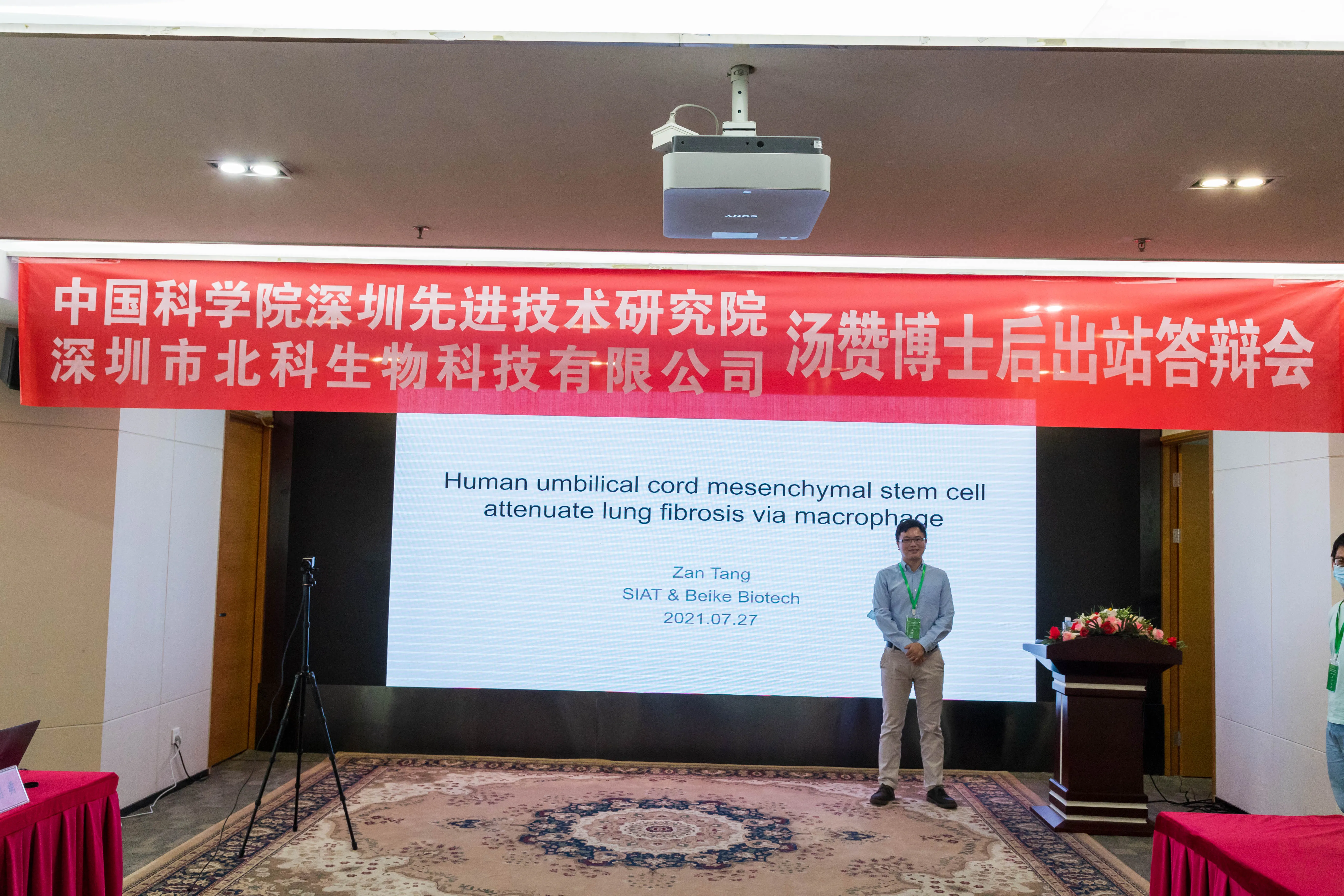
On 27 July, the post-fellowship defense of Dr. Tang Zan – a postdoctoral researcher jointly trained by the Shenzhen Institute of Advanced Technology of the Chinese Academy of Sciences and Shenzhen Beike Biotechnology Co., Ltd. – was held at the Beike Building.
At the defense, Dr. Tang Zan presented his exit defense report titled "Umbilical Cord Mesenchymal Stem Cells Mitigate Pulmonary Fibrosis via Macrophages". The review panel, chaired by Dr. Hu Junyuan and consisting of multiple experts, conducted a comprehensive professional evaluation of Dr. Tang's exit thesis and unanimously concluded that the postdoctoral thesis met the requirements for fellowship completion and approved his exit.
After the review, Dr. Hu Junyuan, Chairman of Beike Biotech, delivered closing remarks. He noted that Beike Biotech's Postdoctoral Innovation Practice Base was approved and established by the Shenzhen Human Resources and Social Security Bureau in 2013, with the aim of fostering an environment for high-end talent cultivation in the cell field and promoting industry-academia-research integration. Dr. Tang Zan's successful completion of his postdoctoral fellowship is a milestone result of Beike Biotech's strategy of driving enterprise innovation and development through technology and talent, and represents a new step up in Beike Biotech's capabilities for cultivating high-level talent.
—— Beike Biotech Postdoctoral Innovation Practice Base ——
In 2013, Beike Biotech was approved by the Shenzhen Human Resources and Social Security Bureau to establish a Postdoctoral Innovation Practice Base, becoming one of 27 entities in Shenzhen designated as a "Postdoctoral Innovation Practice Base" that year.
Shenzhen's Postdoctoral Innovation Practice Base program began in 1995, with host entities chosen primarily from among high-tech enterprises and leading enterprises in various fields. As a leader in its market segment, Beike Biotech's establishment of a Postdoctoral Innovation Practice Base in the cell field demonstrates our scientific capability in the life sciences and our ability to translate innovative scientific and technological achievements. Going forward, in line with the relevant policies and requirements, we will continue to recruit and cultivate postdoctoral researchers, build bridges between high-tech talent and enterprises, accelerate the translation and industrialization of high-tech outcomes, and achieve seamless integration of "industry, academia and research".