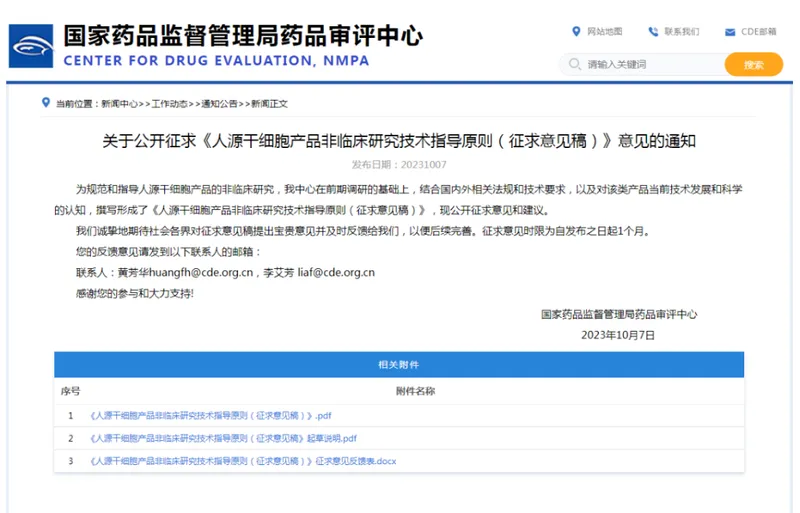
On 20 July 2015, the National Health and Family Planning Commission and the China Food and Drug Administration jointly issued the "Administrative Measures for Stem Cell Clinical Research (Trial)" under document No. Guo Wei Ke Jiao Fa [2015] 48. The Measures are organized into 8 chapters and 55 articles, covering general provisions; conditions and responsibilities of institutions; project initiation and filing; the clinical research process; reporting requirements; the responsibilities of expert committees; supervision and management; and supplementary provisions.
The following is the official interpretation of the Measures:
1. Why must administrative measures for stem cell clinical research be formulated?
Stem cells are a class of multipotent cells with the ability to self-replicate, and under certain conditions can differentiate into multiple functional cell types. Owing to their proliferative and differentiation properties, stem cells can serve as "seed" cells in cell replacement and tissue regeneration. As a key area of frontier medical research in recent years, stem cell research has shown promising prospects, brought hope for the effective treatment of certain difficult diseases and attracted broad attention. China gave priority support to stem cell research in its "12th Five-Year" science and technology plan and has made encouraging progress. Alongside the rapid development of stem cell research and translational application, however, problems have also emerged, such as marked profit-seeking by institutions that charge exorbitant fees; lack of unified standards for stem cell preparation and serious quality risks; and the difficulty of safeguarding subjects' rights and interests in the absence of effective academic and ethical review and informed consent. Stem cell therapies that evade government supervision and lack preclinical research data have repeatedly proven hard to root out. The formulation of relevant administrative measures to regulate stem cell clinical research and fully protect subjects' rights and interests is therefore imperative.
2. What is the scope of application of the Administrative Measures?
The Administrative Measures apply to stem cell clinical research carried out at medical institutions.
The Administrative Measures do not apply to hematopoietic stem cell transplantation, for which mature technical standards already exist, or to stem cell clinical trials applied for under the drug-approval pathway. The Administrative Measures stipulate that, after a medical institution has completed stem cell clinical research in accordance with the Measures, it may not enter clinical application directly; if the institution applies to register a clinical trial for drug registration, the clinical research results already obtained may be submitted as technical application materials and used in drug evaluation.
Source of the interpretation: National Health and Family Planning Commission of the People's Republic of China. The Administrative Measures stipulate that, from the date of issue, stem cell therapy-related technologies will no longer be managed as Class III medical technologies.
3. What principles must stem cell clinical research follow?
Stem cell clinical research must follow the principles of being scientific, regulated and open. Medical institutions must conscientiously fulfill the filing and information-disclosure procedures for stem cell clinical research institutions and projects and accept supervision from relevant national authorities.
Stem cell clinical research must follow ethical principles and fully protect the rights and interests of subjects, in line with the requirements of the "Ethical Review Measures for Biomedical Research Involving Humans (Trial)" and the "Ethical Guidelines for Human Embryonic Stem Cell Research", ensuring that subjects' rights and interests are fully respected and protected.
4. Are fees permitted in stem cell clinical research?
Institutions conducting stem cell clinical research may not charge subjects fees related to the stem cell clinical research, nor publish or otherwise disguise advertising for stem cell clinical research.
5. What are the overall requirements for stem cell clinical research projects?
Stem cell clinical research refers to clinical research in which autologous or allogeneic human-derived stem cells are infused (or transplanted) into the human body after in vitro manipulation, for the prevention or treatment of disease. The Administrative Measures stipulate that research must have a sufficient scientific basis and that the preventive or therapeutic effect must be superior to existing means; or it must be aimed at diseases for which there are no effective interventions, life-threatening conditions and conditions that severely affect quality of life, and major medical and health needs. Stem cell clinical research shall comply with the requirements of the "Good Clinical Practice for Drug Trials" (GCP). Stem cell preparations shall comply with the requirements of the "Guiding Principles for Quality Control and Preclinical Research of Stem Cell Preparations (Trial)".
6. Who is the responsible party in stem cell clinical research?
The Administrative Measures explicitly stipulate that the stem cell clinical research institution is the party responsible for quality management of stem cell preparations and clinical research. The institution shall conduct project review, filing, information disclosure and process supervision for stem cell clinical research projects, and shall carry out quality management and risk control across the entire process of stem cell preparation and clinical research.
7. What conditions must medical institutions meet to conduct stem cell clinical research?
The Administrative Measures stipulate that medical institutions conducting stem cell clinical research must meet seven conditions: 1. tertiary, Grade A hospitals; 2. legally obtained qualification as a drug clinical trial institution in the relevant specialty; 3. strong comprehensive capacity in clinical care, teaching and research; 4. complete conditions for stem cell quality control and a comprehensive quality management system for stem cell clinical research, with an independent quality assurance department for stem cell clinical research; an authorized-person system for stem cell preparation quality; complete quality management and risk control procedures and related documentation covering the entire process of stem cell preparation and clinical research; and an audit system for stem cell clinical research; 5. project leaders and authorized persons for preparation quality must hold senior professional titles, and key research personnel must have undergone Good Clinical Practice (GCP) training; 6. an academic committee and ethics committee suited to the stem cell clinical research being carried out; 7. a management mechanism for preventing risks in stem cell clinical research and measures for handling adverse reactions and adverse events.
8. How shall stem cell clinical research institutions and projects be filed and disclosed?
The Administrative Measures stipulate that, before launching a stem cell clinical research project, clinical research institutions shall, in line with the requirements, conduct academic and ethical review of the project and submit the relevant project initiation paper materials to the provincial-level health and family planning administrative department and the food and drug regulatory department. After review by the provincial-level health and family planning administrative department in conjunction with the food and drug regulatory department, the materials shall be filed with the National Health and Family Planning Commission and the China Food and Drug Administration. At the same time, in accordance with the principle of information disclosure, the clinical research institution shall publicly disclose information about the stem cell clinical research institution and projects in the Medical Research Registration and Filing Information System (URL: http://114.255.123.14) and shall be responsible for ensuring the authenticity of the registered content.
9. How is the stem cell clinical research process managed?
The Administrative Measures require clinical research institutions to supervise researchers in conducting research strictly in accordance with the reviewed and filed research plan. During the clinical research, all original records of all data on stem cell donors and subjects must be accurate and clear and have electronic backups, and shall be retained for 30 years after the end of the clinical research. Tracking records of stem cell preparations shall also be retained for at least 30 years from the date of last processing.
During the research, the institution shall report progress, research results, serious adverse reactions, errors or accidents that occur during the research, the measures taken in response and any rectification actions, in a timely manner, to the national and provincial-level health and family planning administrative departments and food and drug regulatory departments.
After the conclusion of the stem cell clinical research, subjects shall be subject to long-term follow-up monitoring to evaluate the long-term safety and efficacy of the stem cell clinical research.
10. How are subjects' rights and interests effectively protected in stem cell clinical research?
The Administrative Measures stipulate that institutions conducting stem cell clinical research shall strengthen subject protection. Stem cell clinical research personnel must use plain, clear and accurate language to inform donors and subjects of the purpose, significance and content of the stem cell clinical research in which they will be participating, as well as the expected benefits and potential risks, and signed informed consent must be obtained on a voluntary basis. For higher-risk projects, the research institution shall take effective measures to focus its supervision and shall provide corresponding protection to subjects by purchasing third-party insurance.
If a subject experiences a serious adverse event during the stem cell clinical research, such as an infectious disease, permanent damage to body function or organs, life-threatening conditions, death, or the need to receive emergency medical treatment, the researcher shall immediately stop the clinical research.
11. What are the responsibilities of the Stem Cell Clinical Research Expert Committee and the Ethics Expert Committee?
The Administrative Measures stipulate that, as needed for their work, the national and provincial-level health and family planning administrative departments and food and drug regulatory departments shall establish a Stem Cell Clinical Research Expert Committee and an Ethics Expert Committee, and clarify the responsibilities and requirements of these expert committees. The expert committees shall provide technical support and ethical guidance for the management of stem cell clinical research, conduct on-site inspections and assessments of filed medical institutions and research projects, supervise and inspect the institution-level academic and ethics committees in their management of research projects, and promote the regulated conduct of stem cell clinical research.
12. What are the main supervisory measures for stem cell clinical research?
In accordance with the Administrative Measures, national and provincial-level health and family planning administrative departments and food and drug regulatory departments shall strengthen supervision of stem cell clinical research, conducting random checks, special inspections or for-cause inspections of filed stem cell clinical research institutions and projects, and where necessary sampling and testing the institution's stem cell preparations. If a violation of the Administrative Measures occurs, the provincial-level health and family planning administrative department and food and drug regulatory department shall order the institution to suspend the stem cell clinical research project and rectify within a time limit, and shall impose appropriate handling in accordance with the law; if rectification still fails to meet requirements or the circumstances are serious, the National Health and Family Planning Commission and the China Food and Drug Administration shall order the institution to halt stem cell clinical research, give a circulated criticism, and, where the circumstances are serious, deal with the matter in accordance with relevant laws and regulations. Institutions and personnel that conduct research without filing for stem cell clinical research, or that violate the rules and enter clinical application directly, shall be dealt with in accordance with the "Drug Administration Law of the People's Republic of China", the "Regulations on the Administration of Medical Institutions" and other laws and regulations.