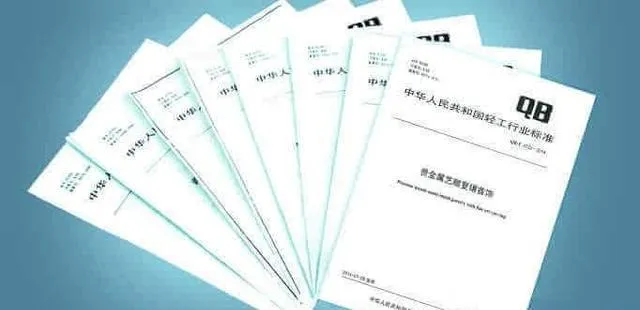
Since the start of the 21st century, the world has entered an era of "accelerated technological progress, globalized economic and trade activity, the proprietization of technical information, and the internationalization of the rules of the game". Market competition has moved beyond competition over products into the higher-level competition over standards: those who command advanced standards command tomorrow's market. The widely heard saying "top-tier enterprises set standards, second-tier enterprises build brands, third-tier enterprises make products" captures a stage-by-stage model of how enterprises ascend in an era of global economic integration. It underscores how important the ability to set standards is to an enterprise's growth.
1
Conditions for project initiation
1. Compliance with current national laws, regulations, and the relevant provisions for standardization;
2. Compliance with the scope and guiding principles for project initiation of national standards;
3. Urgent need from the market and enterprises, alignment with national industrial development policy, and contribution to economic and social benefits;
4. Urgent need from the government and contribution to the regulation of market order;
5. Compliance with the national policy of adopting international standards or advanced foreign standards;
6. No overlap with existing national standards;
7. Falls within the business scope of the proposing organization;
8. Submission of a national standard draft;
9. Completion timeframe not exceeding three years.
2
Project sources
1. Relevant administrative departments of the State Council, industry associations with industry administration functions, enterprise groups, technical committees, and standardization administrative departments of provinces, autonomous regions, and municipalities should put forward proposals for national standards formulation and revision projects in accordance with the project initiation conditions for national standards formulation and revision plans.
2. Public solicitation
Method of soliciting national standards formulation and revision projects from the public: A year-round public solicitation system applies to national standards formulation and revision projects. Any organization or individual may put forward a proposal for a national standards formulation or revision project based on the project initiation conditions. However, in some industries, project initiation applications by units, organizations, or individuals affiliated with enterprises (or public institutions) must additionally be reviewed and recommended by the standardization department of the host organization.
3. Handling of project proposals solicited from the public
After review and coordination by industry departments, national specialized standardization technical committees, and provincial-level quality and technical supervision bureaus, the standards plan projects shall be submitted to the Standardization Administration of China (SAC) via the website.
Industry departments, national specialized standardization technical committees, and provincial-level quality and technical supervision bureaus shall log in to the "National Standards Formulation and Revision Management Information System" with their username and password and submit: standard project proposal + standard draft.
For project proposals solicited from the public, SAC shall, through relevant departments, conduct feasibility studies on the proposals and decide whether to adopt them.
For adopted proposals, SAC shall reply to the proposing organization or individual and authorize the relevant industry administrative department or technical committee to put forward proposals for project initiation.
3
Submission of proposals
(I) Submission
Submitted to: industry departments, national specialized standardization technical committees, and provincial-level quality and technical supervision bureaus, or directly to the Standardization Administration of China (SAC).
Submission contents: standard project proposal + standard draft.
The project proposal shall include the following:
(1) Necessity of formulation or revision;
(2) Status of related national or industry standards;
(3) Main content of the standard;
(4) Completion timeframe;
(5) Other relevant information.
The "Project Proposal" must be prepared using the designated standardized electronic template; please download the "Project Proposal" electronic template from the "Standards Development Workstation" section of the SAC website under "Common Tools".
(II) Handling of national standards formulation and revision projects
SAC conducts an initial review of national standards formulation and revision projects.
Before national standards formulation and revision projects are finalized, public consultation is conducted.
SAC conducts an initial review of national standards formulation and revision projects. Before they are finalized, public consultation is conducted.
Based on the project initiation conditions, SAC organizes coordination among relevant national standards administration bodies and industry departments. Coordinated projects are included in the national standards formulation and revision plan and assigned to the relevant technical committees.
Where a national standards formulation or revision project lacks a designated technical committee, SAC shall designate a relevant technical committee to undertake the work.
(III) Issuance of approved projects
Approved national standards formulation and revision projects are issued and announced quarterly.
Urgent projects may be initiated and announced at any time.
Approved projects are issued together with a planning notice.
Upon receipt of approved projects from SAC, technical committees shall promptly forward them to the drafting organizations and properly carry out supervision and inspection of project execution.
4
Standard development
(I) Standard drafting
1. Once confirmed by the standardization technical committee or sub-technical committee, the drafting organization shall develop a work plan, set up a drafting team, and assign dedicated personnel to lead the drafting. The drafting organization shall draft the standard in accordance with the project initiation requirements; participation by personnel from production, research, marketing, and user sectors in a working group to jointly draft the national standard is encouraged. The work plan and drafting team list shall be filed with the standardization technical committee or sub-technical committee.
2. The drafting organization shall systematically collect and organize relevant domestic and international standards, codes, regulations, and literature, and stay abreast of the current status, development trends, and dynamics of related standards.
3. The hierarchical structure (chapters, clauses, sub-clauses, items), formatting, terminology, formulae, tables, and typefaces of the standard shall comply with GB/T 1.1–1.2.
4. While drafting the standard, an explanatory document shall also be prepared, generally including: (1) A brief account of the work, including the source of the task, list of main participating organizations and working group members, and the work each carried out; (2) The principles for drafting the standard and the rationale for the main content (such as technical indicators, parameters, formulae, performance requirements, test methods, and inspection rules), including experimental and statistical data; for revisions, a comparison between the level of the new and old standards shall be added; (3) Analysis and synthesis reports of major experiments (or validations), technical and economic analysis, and projected economic effects; (4) The extent of adoption of international and advanced foreign standards, comparison with the level of similar international or foreign standards, or comparison with relevant data from foreign samples or prototypes tested; (5) Relationship with current relevant laws, regulations, and standards; (6) Process and basis for resolving major disagreements; (7) Recommendation as to whether the standard should be mandatory or recommended; (8) Recommendations on requirements and measures for implementing the standard (including organizational measures, technical measures, transition arrangements); (8) Recommendation to repeal current relevant standards; (9) Other matters that require explanation. After the draft is completed, the sub-technical committee shall solicit comments on it broadly for one month, and revise it based on the comments received to produce the version submitted for review, while completing a summary table of comments received.
(II) Soliciting comments
1. Upon completion of the draft, the drafting organization shall submit the consultation draft, the explanatory document, and supporting attachments to the secretariat of the sub-technical committee. The secretariat shall conduct a procedural review of the format and content for compliance with the relevant requirements; once approved, the drafting organization shall send the consultation draft, explanatory document, and attachments to selected members and experts at relevant organizations to solicit comments. Where necessary, opinions may be solicited from the public through appropriate means.
2. The experts consulted shall cover relevant fields including research, production, end use, testing and inspection, training, and supervision, with no fewer than 10 of them being committee members.
3. Experts who receive the consultation draft shall provide comments within the specified period, and the number of experts providing feedback shall exceed two-thirds of those consulted. The comment period is 30 days from receipt to reply.
4. The drafting organization shall consolidate, analyse, and address the comments received from experts and revise the consultation draft accordingly, producing a draft for review and a summary table of comments. Comments not adopted shall be supported by sound reasons, which shall be set out in the summary table.
(III) Review and submission for approval
1. The drafting organization shall submit the refined review draft, explanatory document, summary table of comments, and other relevant attachments to the secretariat of the sub-technical committee. The secretariat shall send the review draft to the chairperson for initial review and approval, and then submit it to all members for review. Review may be conducted by meeting or by correspondence.
2. Before review, the drafting organization shall propose a list of reviewing experts and a request for review. The secretariat shall, one month before the review meeting or two months before the correspondence vote, submit the review draft, explanatory document, and relevant attachments (including the correspondence ballot for correspondence reviews) to the reviewers.
3. In meeting reviews, full discussion shall be held to reach consensus where possible. When voting is required, approval requires the consent of at least three-quarters of the representatives present. In correspondence reviews, approval also requires the consent of at least three-quarters of those replying. The attendance rate at meetings and the response rate of correspondence ballots shall be no less than two-thirds.
4. Members who attend the review meeting without expressing comments, and members who fail to vote within the specified period in correspondence reviews, are counted as abstentions.
5. For standards or clauses on which there is disagreement, supporting documentation for the differing views shall be provided. 6. Meeting reviews shall produce meeting minutes; correspondence reviews shall produce a correspondence-review conclusion accompanied by the correspondence ballots. The review of mandatory national standards must be conducted by meeting.
7. The voting results of standards reviews shall be recorded in writing and attached to the explanation of review opinions.
8. In principle, standards reviewed by a sub-technical committee shall not be reviewed again by the parent technical committee; however, for important standards, the technical committee may organize a separate review.
9. For standards that pass review, the drafting organization shall make revisions in accordance with the review opinions, produce the standard for approval, and submit three copies, together with the explanatory document, summary table of comments, and other attachments, to the secretariat of the sub-technical committee. Where international or advanced foreign standards have been adopted, two copies of the original or translated text of those standards shall be attached.
10. When submitting the above materials, the drafting organization shall also provide an electronic version. For mandatory national standards being formulated or revised, Chinese and English notification forms shall also be provided.
11. After the standard for approval has been reviewed by the secretariat of the standardization technical committee and signed by the secretary-general, it shall be sent to the chairperson, or to a vice chairperson designated by the chairperson, for review. After review and approval by the chairperson or designated vice chairperson, the standard shall be submitted to SAC for approval.
(IV) Release and filing
National standards are uniformly numbered and released by SAC.